seq 41Intact
SMS and voice codes are not allowed as a second factor
- control
- GWS.AUTH.003@1
- status
- pass
prev…
hash…
TenantAttest is the tenant hardening evidence platform built for MSPs. It reads a client's Google Workspace tenant against 49 hardening controls, gives your tech the console steps for anything that fails, then reads the setting again. The result is a signed record an insurer or auditor can check without a TenantAttest login.
Not yet available to buy. Design partners will get early access.
A run against a fictional tenant, replayed as it happened.
Three records from a demo run against a fictional tenant. A record's hash covers its contents and the hash before it. Edit the middle record to see what a verifier reports.
SMS and voice codes are not allowed as a second factor
External sharing is limited to allowlisted domains
Automatic forwarding is disabled at the domain level
The three records match their hashes, they point at the record before them, and the signed manifest covers the last one. The chain is intact.
Field names and values are as stored. Hashes are SHA-256, computed in your browser over canonical JSON. Records are trimmed for display; full records carry more fields and are hashed the same way.
Cyber insurance renewals, client security reviews and post-incident calls ask a version of the same question. Was this setting on, for these users, on that date?
A screenshot of the Admin console shows one organizational unit on one day. It doesn't show a child OU that overrides the policy, or an admin who never enrolled in 2-Step Verification. Nothing in the image shows whether it was edited.
TenantAttest reads the setting from Google's APIs, records what it saw and signs the record. Your client, their insurer or an auditor can check it.
Paraphrased from questions on cyber insurance applicationsIs multi-factor authentication enforced for privileged and administrative accounts, for email and remote access?
| Question | Screenshot | TenantAttest Record |
|---|---|---|
| Which organizational units? | The one on screen | Read per OU |
| Are admins enrolled in 2-Step Verification? | Not shown | Listed by account |
| True on which date? | The day it was taken | Timestamp inside a signed chain |
| Edited since? | Can't tell from the image | An edit stops matching the hash |
A control goes through four steps, in this order. It isn't marked as passing until the setting has been read back from Google.
Pull the tenant's live configuration once per run: policies per OU, users, admins and mail-domain DNS.
Read-only scopes through keyless domain-wide delegation. TenantAttest stores no client passwords.A failing control comes with the Admin console steps for your tech, plus the steps to undo the change.
TenantAttest corrects 2 controls itself. Guided steps for 38. 9 are corrected outside Google.The setting is read again. If Google doesn't show the change, the control stays failed.
Cloud Identity Policy API, Directory API and public DNS.Results become records chained to the one before. The run manifest is signed with a Cloud KMS key.
SHA-256 chain, ECDSA P-256 signature. Retention-locked storage is Coming Soon.The next run starts again at Step 1. A setting that moved since the last run is reported as drift, with the field that changed.
It doesn't change tenant settings for you. Only some of these Workspace settings can be changed through Google's API, so for now your tech makes the change in the Admin console and TenantAttest reads it back. Changes through the API, with rollback, are Coming Soon for the settings that allow it.
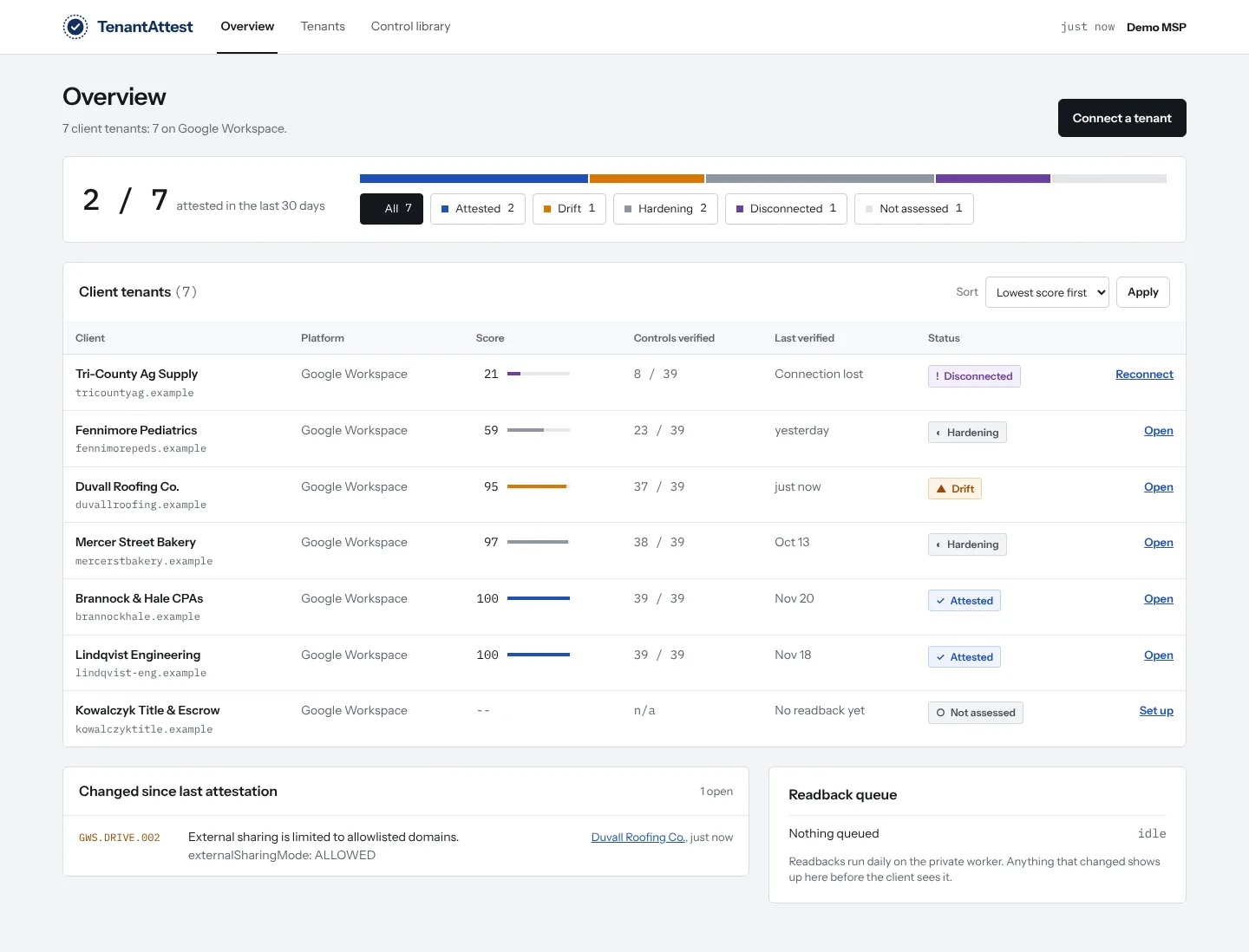
The portal shows which tenants are attested, which have drifted since their last record, which are mid-hardening and which lost their connection. The drift list shows what changed and where.
This table is generated from the control library the engine runs. Controls are mapped to CISA SCuBA baseline policy IDs for reference. A mapping is a summary, not legal advice or a compliance determination.
Records pin the control version, so a later change to a check doesn't alter what an older record meant.
| Control | What It Checks | Severity | Fix | SCuBA Mapping |
|---|
No control matches that search. Try a setting like Takeout or an ID like GWS.DNS.
A run produces three files. To check them, an auditor needs those files, the published public key and the TenantAttest verifier. They don't need a TenantAttest login.
The raw data the worker read ships with the records. An auditor can re-run the evaluation offline and compare the result.
The records are what TenantAttest read and concluded at that time, unchanged since. Checked against the previous run, it also shows no run was dropped.
That Google's API answered correctly. raw.json lets anyone check TenantAttest's reading of the data.
runs/20261122T020917Z-a5e49959/
├── records.jsonl   # one record per control, hash-chained
├── raw.json        # what the worker read
└── manifest.json   # hashes, head of chain, signature
$ tenantattest assess --fixture tests/fixtures/sample_tenant.json ...
WARNING: signed with a local dev key; this run is not customer evidence
23 pass, 26 fail, 0 error of 49

$ tenantattest verify msp/demo/tenant/sample/runs/20261122T020917Z-a5e49959 \
    --public-key local-dev-public-key.pem
OK: 49 records, signature valid, head b5be5e6f26adfce52027ddcb8cbb4c32…
Demo DataReal output from a run against the sample tenant in the repository, signed with a dev key. The head hash is trimmed.
As of November 22, 2026
TenantAttest isn't available to buy yet. There are no MSP logos or testimonials on this page because there are no customers yet.
49 controls running against test tenants, signed hash-chained records with an offline verifier, and an MSP portal that keeps MSPs' data separate. In internal testing.
Running against our own Workspace domain, and MSP sign-in with passkeys.
A client-ready report for a Workspace tenant, backed by its records.
Entra ID and Exchange Online checks.
Changes applied through the API where Google and Microsoft allow it, followed by a readback.
One monthly price per connected client tenant, set by the tenant's size. You don't pay per user, and you can add or remove a client tenant in any month.
| Tenant Size | Users in the Tenant | Per Tenant, per Month |
|---|---|---|
| Small | Up to 25 | $29 |
| Standard | 26 to 100 | $59 |
| Large | 101 to 500 | $119 |
| Over 500 Users | 501 and up | Ask Us |
Prices apply once TenantAttest is available to buy. Until then, design partners use it at no charge.
We're looking for a small group of MSPs that manage Google Workspace clients. Design partners will get early access and a say in what's built. In return, we ask for honest feedback.
Founding rate. Design partners pay half price for the first 12 months after launch, then a quarter off the published prices for the 24 months after that.
Prefer email? Write to [email protected].